
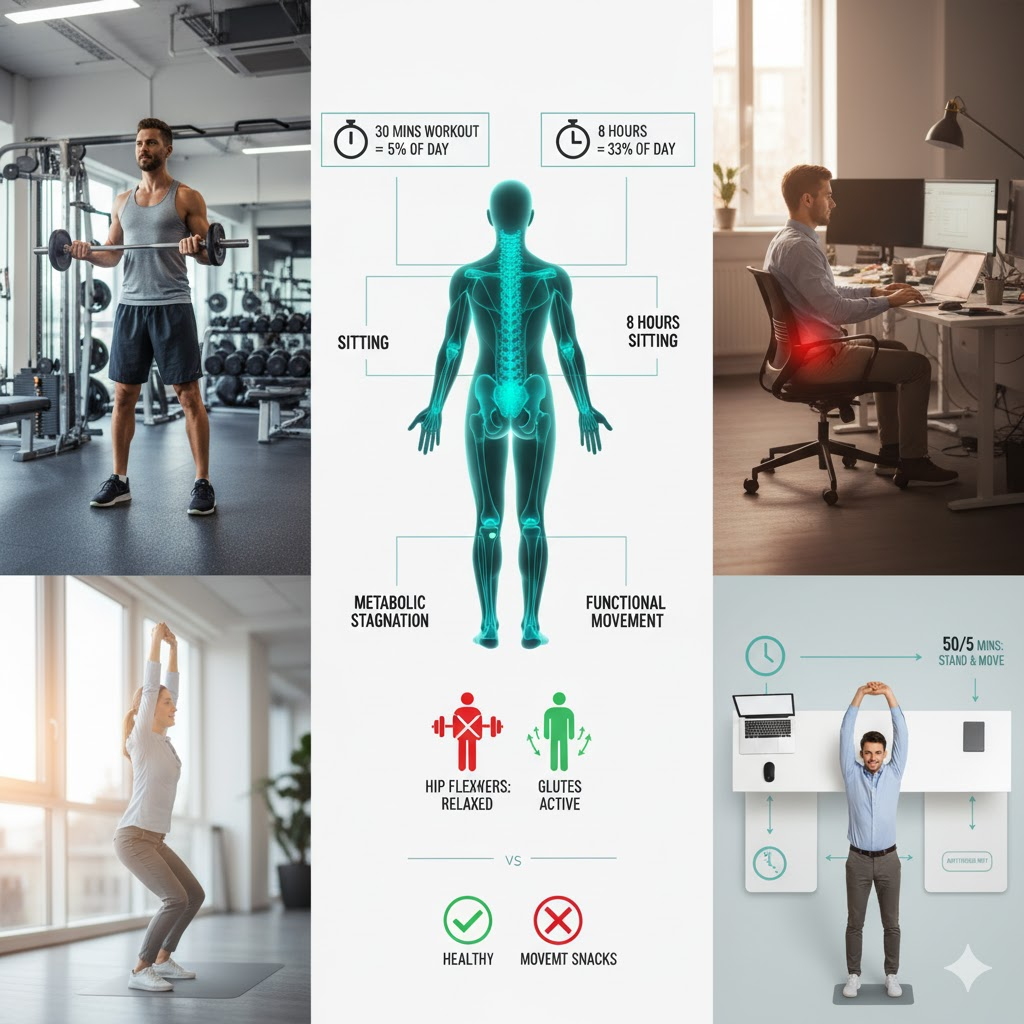
In the digital age, we are facing a silent pandemic: the Sedentary Lifestyle. Even individuals who maintain a 30-60 minute daily gym routine are still at risk for chronic diseases if the remainder of their day is spent sitting. Scientists refer to this phenomenon as the “Active Sedentary” lifestyle.,
1. The Biological Mechanism: Why Does Sitting Cause Harm?
According to research from the American Heart Association (AHA), sitting continuously for over 6 hours a day causes biochemical changes that high-intensity workouts after hours struggle to fully reverse.
Lipase Enzyme Suppression
When the body is at rest (sitting), the activity of Lipoprotein Lipase—an enzyme responsible for breaking down fats in the bloodstream—drops by up to 90%. This leads to fat accumulation and an increased risk of metabolic diseases, regardless of how many heavy squats you perform at the end of the day.
Structural Changes in the Locomotor System (Adaptive Shortening)
Prolonged sitting forces the body to adapt to a misaligned posture:
Hip Flexors: Become permanently shortened, pulling the pelvis forward (Anterior Pelvic Tilt).
Glutes: Fall into a state of “neurological inhibition,” eventually leading to Dead Butt Syndrome.
Spine: The pressure on spinal discs when sitting is over 40% higher than when standing.
2. The Solution: Functional Movement Systems
To fix this, we must shift our mindset from “one-time workouts” to “intermittent movement.” Below is a 3-step roadmap recommended by ergonomics experts.
Step 1: Adopt “Movement Snacks”
Instead of waiting until the end of the day, break your movement into “snacks”:
The 50/5 Rule: For every 50 minutes of work, spend 5 minutes moving.
Benefits: Re-activates metabolism and refreshes the oxygen supply to the brain, helping maintain maximum focus.
Step 2: Re-activate Inhibited Muscle Groups
Use “at-desk” exercises to wake up your muscles:
Glute Squeezes: Squeeze your glutes tightly while sitting, hold for 5-10 seconds. Repeat 10 times.
Desk Upward Stretch: Interlace your fingers, push your palms toward the ceiling to release tension in the neck and shoulders.
Standing Quad Stretch: Stand up and pull your foot back to stretch the front of your thigh.
Step 3: Optimize Your Workspace (Ergonomics)
Monitor Position: The top edge of the screen should be at eye level.
Standing Desks: Alternate between standing and sitting every 30-60 minutes.
Viewing Distance: Keep eyes 50-70cm from the screen to reduce stress on the central nervous system.
3. Economic and Long-term Health Benefits
Implementing functional movements is not just a physical issue; it is a profitable investment:
Increased Productivity: Movement increases blood flow to the brain, improving problem-solving abilities.
Reduced Medical Costs: Prevents spinal diseases, herniated discs, and Type 2 diabetes.
Life Extension: Studies indicate that reducing sitting time improves the length of telomeres (the protective caps on chromosomes associated with longevity).
The Neurological Connection: How Stagnation Dulls the Brain
While the physical impact of a sedentary lifestyle is often visible through weight gain or back pain, the most profound damage may be occurring within our cranium. Modern neuroscience has discovered a direct link between lower-body movement and cognitive vitality. When we sit for extended periods, we aren’t just resting our muscles; we are essentially “starving” our brain of the biochemical triggers it needs to function at peak performance.
The BDNF Factor and Neuroplasticity
Physical activity, even at low intensities like walking or standing stretches, stimulates the production of Brain-Derived Neurotrophic Factor (BDNF). This protein acts like “miracle-gro” for the brain, supporting the survival of existing neurons and encouraging the growth of new ones. Continuous sitting leads to a significant decline in BDNF levels, which is closely associated with “brain fog,” reduced creativity, and an increased risk of cognitive decline over time. By incorporating “Movement Snacks,” you aren’t just burning calories; you are actively re-priming your brain’s hardware for complex problem-solving.
Cerebral Blood Flow and Glucose Metabolism
The brain is a metabolic glutton, consuming about 20% of the body’s energy. Research using specialized imaging shows that prolonged sitting leads to a “pooling” of blood in the lower extremities, which can subtly reduce the efficiency of cerebral blood flow. Furthermore, because sitting suppresses the Lipoprotein Lipase enzyme (as mentioned earlier), the brain’s ability to efficiently metabolize glucose—its primary fuel source—is compromised. This is why you often feel a “slump” in the mid-afternoon; it is less about a lack of caffeine and more about a lack of circulation.
The Cortisol Trap
Finally, a static body often leads to a static mind, which is more prone to the “stress response.” Sitting in a hunched position (the typical computer posture) mimics a defensive physiological state, which can elevate baseline cortisol (the stress hormone) levels. Intermittent movement breaks this feedback loop, sending a signal to the central nervous system that the environment is safe, thereby lowering anxiety and improving emotional regulation throughout the workday.
Conclusion
Gym training is excellent for overall health, but it is not a “license” to remain motionless for the other 23 hours. Make movement part of your workflow. Remember: The best movement is your next movement.
Disclaimer: The information in this article is for reference purposes only. If you have spinal pathologies, consult a medical specialist before performing these exercises.