
ProcrastinationProcrastination is often described as the “thief of time,” but in reality, it is more like a thief of mental energy.
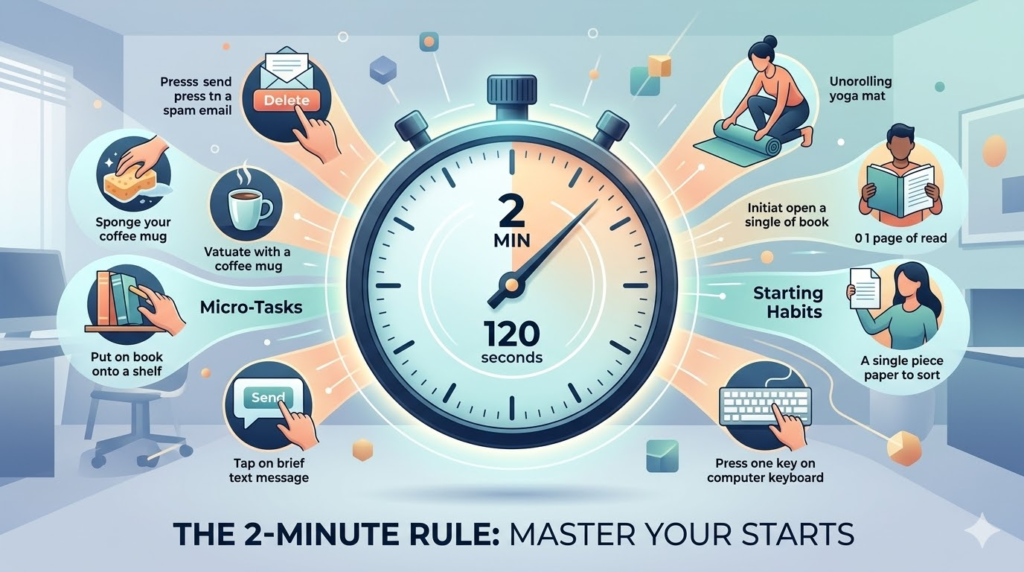
We all have those tiny tasks—sending a quick email, hanging up a coat, or filing a document—that we put off because they seem “too small” to matter. However, these small tasks accumulate into a mountain of mental clutter that leads to burnout and stress.Early in my productivity journey, I realized that the hardest part of any task isn’t the work itself; it’s the starting. This is where the 2-Minute Rule comes in. Borrowed from David Allen’s “Getting Things Done” (GTD) methodology and popularized further by James Clear in “Atomic Habits,” this rule is the simplest yet most effective weapon against procrastination.1. What Exactly is the 2-Minute Rule?The concept is deceptively simple: If a task takes less than two minutes to complete, do it immediately.Don’t add it to a to-do list. Don’t set a reminder for later. Don’t think about it. Just do it.The Psychology Behind the RuleWhy is 2 minutes the “magic number”? It’s because two minutes is a short enough window that your brain cannot justify an excuse to avoid it. We often procrastinate because we perceive tasks as large, looming obstacles. By committing to just two minutes, we lower the “activation energy” required to start.Once you start a task, the Zeigarnik Effect kicks in—a psychological phenomenon where our brains remember incomplete tasks more than completed ones. By starting for two minutes, your brain naturally wants to finish what it began.2. The Two Versions of the RuleTo truly master this principle, you need to understand its two distinct applications:Version A: The Immediate Completion (For Small Tasks)This is for the “micro-tasks” that clutter our lives. If you see a piece of mail on the counter, don’t leave it there—sort it now. If you finished your coffee, wash the mug now. By doing these tasks immediately, you prevent the “pile-up” effect.Version B: The “Starting” Ritual (For Large Goals)How do you apply a 2-minute rule to writing a book or running a marathon? You focus on the first two minutes.Goal: Read more books $\rightarrow$ 2-Minute Version: Read one page.Goal: Practice Yoga $\rightarrow$ 2-Minute Version: Take out your yoga mat.Goal: Study for an exam $\rightarrow$ 2-Minute Version: Open your textbook to the first chapter.The idea is to make your habits as easy as possible to start. You can’t improve a habit that doesn’t exist.3. Why This Rule is a “Game Changer” for Mental HealthProcrastination isn’t a time-management problem; it’s an emotion-regulation problem. We avoid tasks because they make us feel anxious, bored, or overwhelmed.When we let small tasks pile up, our brain enters a state of constant “background processing.” This leads to decision fatigue. Every time you look at a messy desk or an unread message, you are making a subconscious decision to “do it later,” which drains your willpower.The 2-Minute Rule clears this background noise. It provides a sense of “small wins,” which releases dopamine and builds the momentum needed for larger projects.4. The 20-Task Checklist: Clean Up Your Life in 2 MinutesTo help you get started, here are 20 tasks that take 120 seconds or less but will drastically improve the quality of your daily environment and mental space.Digital DeclutterUnsubscribe from 3 junk emails: Stop the clutter before it reaches your inbox.Clear your desktop: Move random files into a “to-process” folder or delete them.Respond to that one “hanging” text: Close the loop on a social obligation.Delete 5 blurry photos: Free up cloud storage and mental space.Physical EnvironmentMake your bed: It sets the tone for the entire day.Wipe down the kitchen counter: A clean surface invites calm.Water one plant: A small act of nurturing.Hang up your coat/bag: Don’t just drop it on the chair.Empty the trash can: Remove the physical “waste” from your view.File one piece of paper: That bill or receipt that’s been sitting out.Mental & Personal GrowthWrite down your Top 3 goals for tomorrow: Reduce morning anxiety.Do a “Brain Dump”: Spend 2 minutes writing down everything stressing you out.Stretch your neck and shoulders: Physical tension often mirrors mental tension.Take 5 deep breaths: Reset your nervous system.Put one item in a “to-donate” box: Practice the art of letting go.Professional EfficiencyClean your computer screen/glasses: Clarity of sight leads to clarity of thought.Organize your pens and stationery: Remove the friction of “searching for tools.”Update your calendar: Add that one event you’ve been meaning to record.Send a “Thank You” note: Build professional relationships in seconds.Clear your browser tabs: Close anything that isn’t essential to your current task.5. Common Pitfalls: When the 2-Minute Rule FailsWhile powerful, the rule can be misused. Here is how to avoid the traps:The Trap of “Fake Work”: Don’t use the 2-Minute Rule to avoid your most important, difficult task (The “Eat the Frog” principle). Doing 50 small tasks but ignoring your main project is still procrastination.The Trap of Interruption: If you are in a state of “Deep Work,” do not stop to wash a mug just because it takes 2 minutes. The rule is for transitions or when you are in maintenance mode.Overestimating Time: Some tasks look like they take 2 minutes but actually take 20. If you start a “quick” closet clean and it turns into a 2-hour project, you’ve broken the rule. Be strict with the clock.6. How to Build the “2-Minute Habit”Start small. I recommend choosing just one time of day—perhaps right after you walk through the front door after work—to apply the rule religiously for one week.Notice how the physical space around you begins to open up. Notice how the “nagging voice” in your head starts to quiet down. Productivity isn’t about working harder; it’s about removing the friction that stops you from working at all.