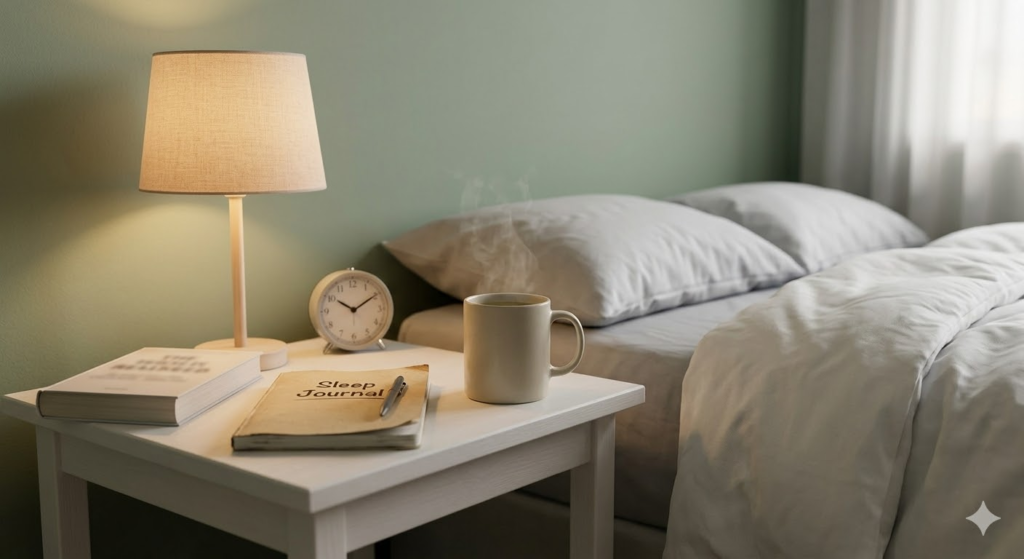
A serene, warm, and minimal bedside setup with herbal tea and a journal, perfect for healthy sleep hygiene.
Medical Disclaimer: I am sharing my personal experience with sleep improvement. The following tips are for informational purposes and should not replace professional medical advice or treatment for clinical sleep disorders.
For the longest time, I was a member of the “3 AM Club.” I would toss and turn, staring at the ceiling while my mind raced with tomorrow’s to-do list. I relied on double shots of espresso to survive the day, only to find myself “tired but wired” at night.
Everything changed when I stopped looking for a “magic pill” and started focusing on Sleep Hygiene. These are the 7 realistic habits I personally implemented to fix my sleep-wake cycle. If you are struggling with midday fatigue, these might be the missing pieces of your puzzle.
1. The “Digital Sunset” at 9 PM
My biggest mistake was scrolling through social media right before bed. The blue light from my phone was essentially telling my brain it was still daytime.
My Experience: I started a “Digital Sunset.” One hour before bed, I put my phone in a different room.
The Result: Instead of mindlessly scrolling, I started reading physical books. Within three days, I noticed I was falling asleep much faster without that “screen-induced” headache.
2. Crafting My “Sleep Sanctuary” (The 18°C Rule)
I used to sleep in a warm room with too many blankets. I learned that the human body needs its core temperature to drop slightly to initiate sleep.
My Adjustment: I set my thermostat to around 18-20°C (65-68°F) and switched to breathable cotton sheets.
My Tip: Keeping the room dark and cool made it feel like a “cave,” which is exactly what our biology craves for deep rest.
3. The Consistency Contract
I used to “catch up” on sleep during weekends, waking up at 11 AM on Sundays. This gave me “social jetlag” every Monday.
My Experiment: I committed to waking up at 7:00 AM every single day, even on Saturdays and Sundays.
Why it worked: After about two weeks, my body started getting naturally sleepy at 11 PM. Consistency is the most powerful tool for your internal clock (Circadian Rhythm).
4. Swapping Late-Night Snacks for Herbal Tea
I used to eat heavy snacks or drink wine late at night, thinking it made me sleepy. In reality, it made my heart rate spike while I slept.
What I do now: I replaced the snacks with a warm cup of Chamomile or Magnesium tea.
Observation: It became a psychological “anchor.” The smell of the tea now signals my brain that the day is officially over.
5. The “Brain Dump” Journaling
A major reason for my insomnia was “overthinking.” I would remember a random task and stress about it for an hour.
My Ritual: I keep a notebook on my nightstand. Before I lie down, I write down three things I’m grateful for and three tasks for tomorrow.
The Benefit: By putting it on paper, I “transfer” the stress out of my head, allowing my mind to finally settle down.
6. Morning Sun Exposure (The Anchor)
I learned that sleep quality actually starts the moment you wake up.
My Routine: I try to get 10-15 minutes of direct sunlight as soon as possible after rising.
The Science: This helps regulate cortisol and sets the timer for melatonin production 16 hours later. It’s the easiest way to feel “awake” in the morning.
7. Avoiding the “Napping Trap”
I used to take 2-hour naps at 4 PM, which ruined my nighttime sleep.
My Fix: If I’m exhausted, I limit myself to a 20-minute “Power Nap” before 3 PM. Anything more, and I wake up groggy and unable to sleep at night.
Final Thoughts
Fixing your sleep isn’t about one big change; it’s about these small, consistent signals you send to your brain. It took me about 21 days to really feel the difference, but now, I wake up feeling refreshed without needing an alarm clock.
What is the one thing keeping you awake tonight? Let’s talk about it in the comments!
References & Sources:
Personal sleep logs (2024-2025).
General principles of Sleep Hygiene from the National Sleep Foundation.
Circadian rhythm research summaries from NIH.