
Your EnergyHave you ever wondered why you feel exhausted after nine hours of sleep, yet occasionally feel strangely alert after only six?
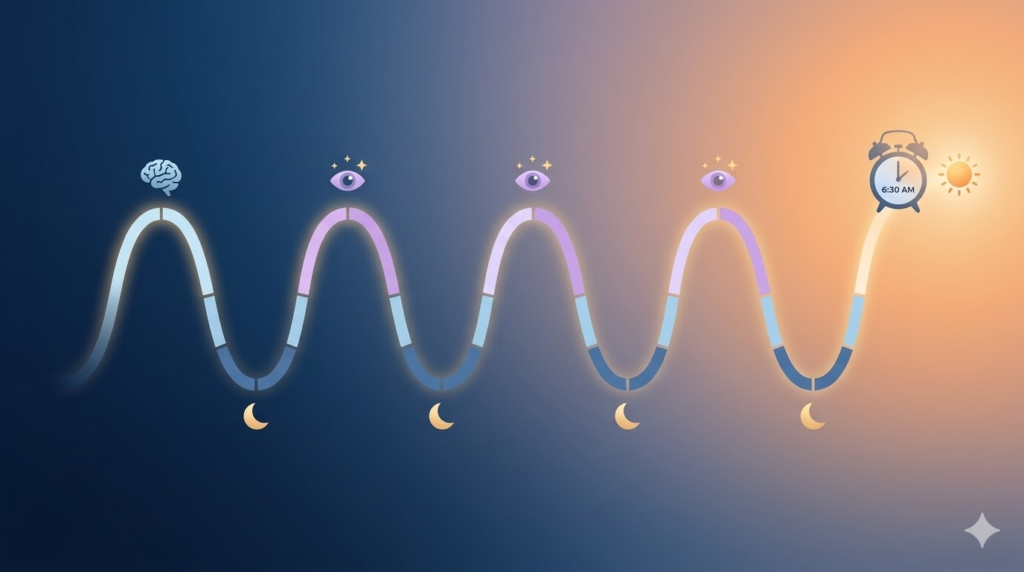
For years, I struggled with “morning brain fog,” a persistent grogginess that no amount of coffee could fix. I thought the answer was simply “more sleep.” I was wrong.The breakthrough came when I discovered the 90-minute sleep cycle rule. By shifting my focus from the quantity of hours to the quality of cycles, I transformed my productivity and mental clarity. This guide explores the science behind sleep architecture and provides a step-by-step roadmap to mastering your rest.1. The Science of Sleep: Beyond the “Off” SwitchTo understand why we wake up tired, we must first dispel the myth that sleep is a passive state. Your brain is incredibly active during the night, performing vital “housekeeping” tasks. These tasks occur in stages that repeat every 90 minutes on average.The Four Stages of a Single CycleStage N1 (Light Sleep): This is the “falling asleep” phase. It lasts only a few minutes. Your muscle activity slows down, and you can be easily awakened.Stage N2 (Slightly Deeper Sleep): Your heart rate slows, and your body temperature drops. This stage accounts for about 50% of your total sleep time.Stage N3 (Deep Sleep/Slow Wave Sleep): This is the most critical stage for physical recovery. Your body repairs tissues, builds bone and muscle, and strengthens the immune system. If you are woken up here, you will feel incredibly disoriented.REM (Rapid Eye Movement): This is where the magic happens for your mind. Your brain activity increases to levels similar to when you’re awake. REM is essential for memory consolidation, emotional processing, and creativity.Why 90 minutes? While the exact length varies slightly from person to person (ranging from 70 to 120 minutes), 90 minutes is the biological average for a human to complete these four stages.2. The Danger of “Sleep Inertia”The reason you feel like a “zombie” in the morning isn’t usually lack of sleep—it’s Sleep Inertia. This happens when your alarm clock interrupts the Stage N3 (Deep Sleep).When you are ripped out of deep sleep, your brain is flooded with adenosine (a chemical that promotes sleep), and it can take up to two hours for your prefrontal cortex to fully “boot up.” By calculating your 90-minute cycles, you aim to time your alarm for the end of a REM stage or the beginning of a new N1 stage, when your brain is already close to wakefulness.3. How to Calculate Your Perfect Sleep WindowIf you want to wake up feeling refreshed, you should aim for either 5 cycles (7.5 hours) or 6 cycles (9 hours).The Math of Performance3 Cycles (4.5 hours): Survival mode. Only recommended for emergencies.4 Cycles (6 hours): Manageable for some, but often leads to a cognitive deficit over time.5 Cycles (7.5 hours): The “Sweet Spot” for the vast majority of healthy adults.6 Cycles (9 hours): Ideal for athletes or those recovering from illness.My Personal Routine: The Backwards CalculationI always start with my “Required Wake-up Time.” Let’s say I need to be at my desk by 8:00 AM, so I want to wake up at 6:30 AM.Count Back 7.5 hours: 6:30 AM $\rightarrow$ 5:00 AM $\rightarrow$ 3:30 AM $\rightarrow$ 2:00 AM $\rightarrow$ 12:30 AM $\rightarrow$ 11:00 PM.Factor in “Sleep Onset”: It takes the average person 14–20 minutes to fall asleep.The Result: I need to be in bed, lights out, by 10:40 PM.4. Factors That Disrupt Your Cycles (And How to Fix Them)Knowing the math is one thing; staying in the cycle is another. Many external factors can “reset” or fragment your cycles, preventing you from reaching Deep Sleep or REM.Blue Light and MelatoninYour brain produces melatonin when it perceives darkness. The blue light from your smartphone mimics sunlight, tricking your brain into thinking it’s daytime.Solution: Use a blue light filter after 8:00 PM or, better yet, put the phone in another room 30 minutes before bed.Alcohol: The Sleep ThiefMany people use a “nightcap” to fall asleep faster. While alcohol helps you drift off (N1 stage), it acts as a massive disruptor of REM sleep. You’ll likely wake up frequently in the second half of the night as the alcohol wears off.Temperature RegulationYour core body temperature must drop by about 1-2 degrees Celsius to initiate deep sleep.Solution: Keep your bedroom cool (around 18°C or 65°F). A warm shower before bed can actually help; when you step out, your body temperature drops rapidly, signaling it’s time for sleep.5. What If You Have a Bad Night?We are humans, not machines. Sometimes work, stress, or children interrupt our plans.If I know I can only get 5 hours of sleep, I don’t try to squeeze in every last minute. Instead, I try to time it for 4.5 hours (3 full cycles). It sounds crazy, but waking up at the end of 3 cycles often feels better than waking up after 5 hours and being dragged out of a deep sleep stage.The Golden Rule: It’s better to have fewer complete cycles than more interrupted ones.6. Integrating the 90-Minute Rule into a High-Performance LifestyleSleep is the ultimate “biohack.” When you master your cycles, you’ll notice:Improved Memory: Your brain “saves” what you learned during the day.Emotional Regulation: You are less likely to be irritable or stressed.Physical Gains: Your muscles recover faster from workouts.