
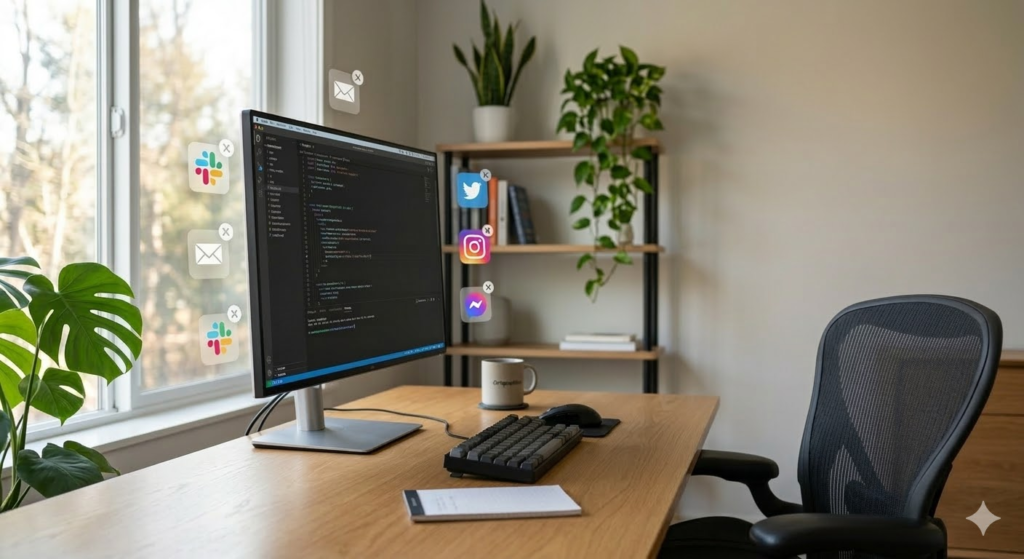
We wear “multitasking” like a badge of honor. In modern job descriptions, it is often listed as a required skill. We pride ourselves on our ability to join a Zoom call while answering emails, checking Slack notifications, and perhaps even shoveling down lunch—all at once. We feel incredibly productive. But are we?
As it turns out, the psychology and neuroscience behind this chaos tell a different story. What we call multitasking is usually task-switching, and it is chemically draining our brains, driving up stress levels, and destroying the quality of our work. At Orhpositivo, we believe that true positive energy comes from alignment and clarity. To reclaim your focus and create exceptional work, you must embrace the ancient, yet revolutionary, power of Monotasking.
1. The Great Myth of Multitasking
For a long time, I was a proud practitioner of multitasking. I believed that by forcing my brain to handle multiple inputs, I was “hacking” my productivity. I was wrong. The human brain, specifically the prefrontal cortex (the part responsible for focus and decision-making), is biologically incapable of focusing on two complex tasks simultaneously.
What Is Actually Happening? (Task-Switching)
When you think you are multitasking, your brain is actually doing what neuroscientists call context-switching or task-switching. It is rapidly flickering its attention back and forth between tasks.
Example: You are writing a report (Task A), and you hear an email notification. You look at the email (Task B), then go back to writing (Task A).
The Cost: Every time you switch, there is a biological “startup cost.” Your brain has to load the context for Task B, then reload the context for Task A. This consumes massive amounts of glucose and oxygen—the brain’s primary fuel.
2. The Psychology of “Attention Residue”
One of the most profound psychological concepts in modern productivity is Attention Residue, a term coined by Sophie Leroy at the University of Minnesota.
My Struggle with The Invisible Anchor
I used to finish a client call and immediately dive into writing a complex proposal. I couldn’t understand why I felt so sluggish and distracted. I realized I was suffering from severe Attention Residue.
How It Works: When you switch from Task A to Task B, a part of your attention remains stuck on Task A. Your brain is still processing the conversation, the emotions, or the problems from the first task, preventing you from fully dedicating your cognitive resources to the second.
The Multitasking Trap: By constantly switching tasks, you accumulate massive layers of Attention Residue. By 3 PM, your brain feels like a bogged-down computer, unable to perform even simple tasks because too many “subconscious background apps” are running.
3. The Biological Damage: Stress, Dopamine, and IQ Drops
Embracing Monotasking isn’t just about finishing your to-do list; it’s about preserving your mental health.
The Cortisol Trap
Multitasking puts your brain in a perpetual state of hyper-vigilance. Your brain perceives every notification as a potential threat. This constantly spikes cortisol (the stress hormone) and adrenaline. This chronic stress feedback loop leads to Adrenal Fatigue, burnout, and that familiar feeling of being “wired but tired.”
The Fake Dopamine Rush
Multitasking feels good because it creates a dopamine loop. Every time you check a small task (like an email or a tweet), your brain releases a tiny squirt of dopamine—the “feel-good” hormone. But this dopamine is cheap. It’s a rewarding loop for busyness, not effectiveness. Monotasking requires you to delay that dopamine rush until the big task is actually complete.
The Stunning IQ Loss
Research from the University of London found that multitasking can cause a temporary drop in IQ of up to 10 points—the same cognitive impairment caused by staying up all night or smoking marijuana. You are essentially working drunk when you attempt to multitask.
4. The Antidote: How to Master Monotasking
Transitioning from a world of chaos to Monotasking requires structure and willpower. It is a biological reset. Here is my personal, step-by-step roadmap to reclaiming your focus.
Step 1: Design Your “Sacred Work” Sanctuary
As we learned in our previous guide on Biohacking Your Home Office, your environment dictates your biology.
The One-Screen Rule: Close all tabs that are not related to your current task. Better yet, full-screen your primary application.
Phone in Another Room: A study from UT Austin found that even the presence of your smartphone—even if it is face down and silent—reduces your cognitive capacity. Put it in a drawer or another room.
Step 2: Implement “Time-Blocking”
Instead of working on a project “whenever you have time,” carve out a dedicated “Sacred Hour.”
My Strategy: I block 9:00 AM to 11:00 AM specifically for my “Big Rock” task (like writing this article). During this block, I am “Monotasking.” I do not check Slack, I do not look at my phone, and I do not “just check” one email.
Step 3: Embrace the “Movement Snack” (The Orhpositivo Way)
To maintain the mental stamina required for Monotasking, you must treat your body with respect.
The Ultradian Rhythm: Work intensely for 90 minutes (Monotasking), then take a 10-20 minute Movement Snack. Stand up, walk outside, or simply stare at a plant. This movement flushes oxygen to the prefrontal cortex, resetting your focus.
5. The Professional Benefits: Quality over Quantity
Monotasking is not about doing less; it’s about doing the right things spectacularly well.
Unlocking “Deep Work”
Cal Newport, author of Deep Work, states that Monotasking is the gateway to producing world-class results. When you are single-tasking, your focus deepens. You can hold complex ideas in your mind, make unique connections, and solve problems that are impossible to solve while distracted.
Emotional Regulation and Team Dynamics
When you practice Monotasking during meetings or conversations (meaning you actually listen instead of typing on your laptop), you are practicing Presence. This drastically improves emotional intelligence and relationship dynamics. True positivity (Orhpositivo) is fostered through genuine connection, not distracted half-attention.
Conclusion: A Positive Mind Is a Focused Mind
We are not victims of our technology or our job descriptions. The choice to multitask or monotask is yours. Choosing Monotasking in a world addicted to multitasking is a radical act. It is a choice to value your sanity, your cognitive health, and the quality of your output.
Start small. Tomorrow morning, choose one task, set a 25-minute timer, and do nothing but that task. Close the tabs. Mute the phone. Feel the immediate shift from “frenzied” energy to “focused” flow. A positive life (Orhpositivo) is built one focused, intentional moment at a time.
Disclaimer
The information provided in this article is for educational and lifestyle purposes. While environmental and cognitive shifts can significantly reduce stress and improve focus, they are not a substitute for professional mental health counseling or ergonomic advice. If you are experiencing chronic anxiety, ADHD-related symptoms, or professional burnout, please consult a qualified healthcare specialist.