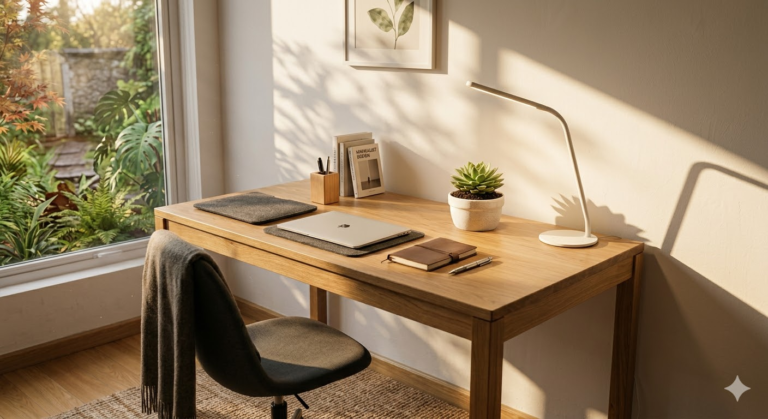

In the modern workspace, whether you are a remote freelancer or a corporate executive, your desk is more than just a piece of furniture. It is a physical manifestation of your mental state. We often hear the phrase, “A cluttered desk is a sign of a cluttered mind,” but is there scientific truth behind this? As it turns out, the psychology of a clean desk is deeply rooted in how our brains process information and manage stress.
By embracing minimalism in our physical environment, we can unlock higher levels of cognitive performance, reduce anxiety, and foster a “positive” workflow—true to the spirit of Orhpositivo.
1. The Science of Visual Clutter and Cognitive Load
To understand why a clean desk works, we first need to look at how the human brain functions. Our visual system is constantly scanning the environment. Even when you are staring at your computer screen, your brain is subconsciously processing every object in your peripheral vision: that half-empty coffee mug, the stack of unpaid bills, and the tangled mess of chargers.
The Competition for Attention
Neuroscientists at Princeton University found that physical clutter in your surroundings competes for your attention. This competition results in decreased performance and increased stress. When your environment is filled with “visual noise,” your brain’s functional capacity is spread thin.
Think of your brain like a computer’s RAM. Every unnecessary object on your desk is a “background app” running in your mind. The more apps you have open, the slower your primary task runs. Minimalism shuts down those background apps, allowing your full cognitive power to focus on the task at hand.
2. The Stress Connection: Cortisol and the Cluttered Environment
There is a direct physiological link between mess and stress. A study published in the Personality and Social Psychology Bulletin revealed that individuals who described their homes as “cluttered” or full of “unfinished projects” had higher levels of cortisol—the body’s primary stress hormone.
Why Clutter Triggers Anxiety:
Overstimulation: Too much to look at overloads the senses.
Guilt: A mess often reminds us of things we haven’t done (e.g., filing papers, cleaning).
Lack of Control: When you can’t find your pen or a specific document, it triggers a “fight or flight” response, making you feel out of control.
By clearing your desk, you send a signal to your nervous system that the “threat” is gone. A clean surface promotes a sense of calm and mastery over your environment, which is essential for creative problem-solving.
3. How Minimalism Enhances “Deep Work”
Cal Newport, author of Deep Work, emphasizes that the ability to focus without distraction is a “superpower” in our economy. Minimalism is the physical foundation of this superpower.
Reduced “Switching Costs”
Every time your gaze drifts to a random object on a messy desk, you experience a “micro-distraction.” Even if it only lasts a second, it takes your brain several minutes to return to a state of deep flow. On a minimalist desk, there are no micro-distractions. Your focus stays locked, leading to what psychologists call the “Flow State”—where time seems to disappear and productivity soars.
I used to believe that a messy desk was a badge of honor—a sign that I was “too busy” and “too creative” to worry about something as trivial as organization. My workspace was a graveyard of sticky notes, tangled USB cables, and at least three different notebooks for the same project. I told myself I knew exactly where everything was. But in reality, I was exhausted before my workday even began.
The turning point came on a Tuesday afternoon when I spent 15 minutes looking for a single SD card. That frustration boiled over, and I decided to clear everything. I mean everything. I left only my laptop and a glass of water.
The result was immediate and almost startling. For the first time in months, the “static noise” in my head went silent. Without the visual reminders of half-finished tasks staring at me. I realized that my messy desk wasn’t just a physical problem; it was an anchor dragging down my mental speed. Since that day, I’ve treated my desk like a sacred space. If it doesn’t help me create, it doesn’t deserve a spot on my surface. This shift in lifestyle is exactly what Orhpositivo stands for: finding the “positive” flow by removing the unnecessary weight.
4. The Functional Roadmap: How to Setup a Minimalist Desk
Transitioning to a clean desk isn’t about throwing everything away; it’s about curation. Here is a step-by-step ergonomic and psychological guide.
Step 1: The “Essential-Only” Rule
Clear everything off your desk. Only put back the items you use every single day. For most, this is:
A laptop/monitor.
A keyboard and mouse.
A notebook and one pen.
A bottle of water.
Everything else—staplers, extra pens, old receipts—should go into a drawer or be discarded.
Step 2: Cable Management (The Silent Distraction)
Visible wires are perceived by the brain as “chaos.” Use cable sleeves or under-desk trays to hide them. The goal is to have as few visible lines as possible.
Step 3: Introduce “Living” Minimalism
Add one small plant. Research shows that “Greenery” in a minimalist setting can increase productivity by 15%. It provides a “soft” focal point that rests the eyes without distracting the mind.
5. Beyond the Physical: The Productivity Benefits
A minimalist desk provides tangible returns on your time and energy investment:
Faster Start Times: When you sit down to a clean desk, you can start working immediately. You don’t have to “clear a path” first.
Enhanced Memory: A focused mind encodes information more effectively.
Increased Professionalism: In a world of Zoom calls and open offices, your desk reflects your reliability and attention to detail.
6. Maintaining the Habit: The “End-of-Day” Reset
Minimalism is a practice, not a one-time event. The most successful professionals use the “5-Minute Reset” strategy.
At the end of every workday, spend five minutes returning your desk to its “minimalist baseline.” Throw away scraps of paper, put your pen back, and wipe down the surface. When you arrive the next morning, you are greeted by a fresh start, preventing the “stress accumulation” that leads to burnout.
Conclusion: A Positive Space for a Positive Life
The psychology of a clean desk is ultimately about respecting your mental energy. By removing the unnecessary, you make room for the extraordinary. At Orhpositivo, we believe that health isn’t just about what you eat or how you move—it’s about how you design your life for peace and productivity.
Minimalism isn’t about having a boring space; it’s about having a focused soul. Start today: clear one square foot of your desk, and feel the immediate shift in your mental clarity.
Disclaimer
The information provided in this article is for educational and lifestyle purposes. While environmental changes can significantly reduce stress, they are not a substitute for professional mental health counseling. If you are experiencing chronic anxiety or burnout, please consult a qualified specialist.