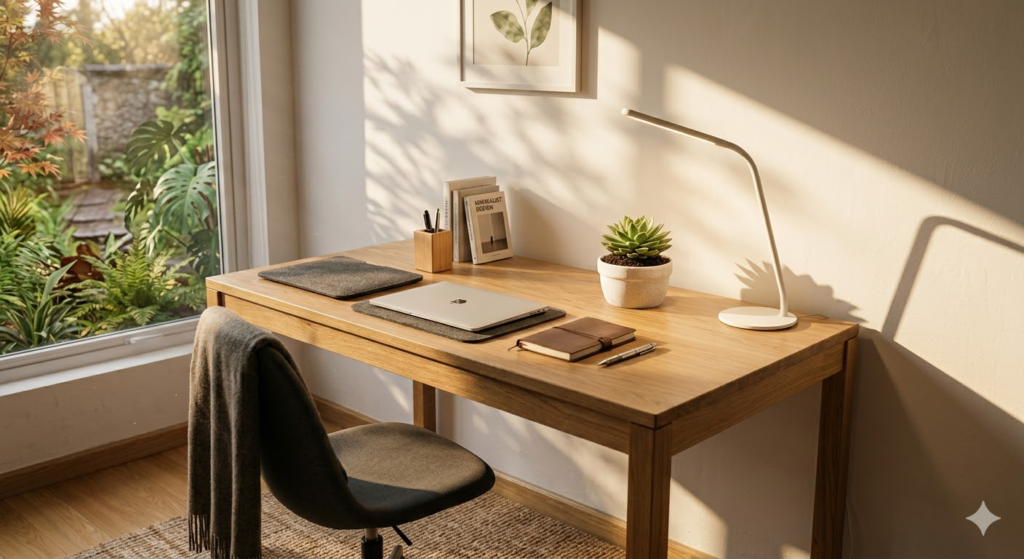
For the longest time, I believed that a “productive” desk was one filled with gadgets, multiple monitors, and stacks of notebooks. I thought more tools meant more output. However, my facts and figures told a different story. My screen time was up, but my actual “Deep Work” hours were declining.
I decided to conduct a Workspace Audit. I stripped my desk bare and slowly added back only the items that provided a measurable boost to my concentration. After 30 days of testing, I discovered that my focus didn’t come from high-tech toys, but from five specific essentials. Here is the data-backed audit of my modern workspace.
1. The Single-Monitor Strategy (Reducing Digital Friction)
We’ve been told that dual monitors increase productivity by 10-20%. For some, that’s true. But for me, the second screen was a “distraction magnet.” It was where my email, Slack, and YouTube lived while I was trying to write.
The Change: I switched back to a single, high-quality monitor.
The Result: By forcing myself to look at only one task at a time, I reduced my “task-switching” cost. According to psychology, every time we switch tasks, we lose up to 40% of our productive time.
My Figure: My average time to complete a 1,000-word article dropped from 3 hours to 1.5 hours.
2. Dedicated “Analog” Space for Brainstorming
In a world of tablets and styluses, I found that my brain processes information differently when I use a physical pen. Digital tools often lead to “fiddling” with fonts and layouts rather than thinking.
The Essential: A high-quality, dot-grid notebook and a single black pen.
Why it works: Physical writing engages more areas of the brain associated with memory and learning.
The Habit: I now spend the first 15 minutes of my workday away from the screen, sketching out my goals in my notebook. This “Analog Start” has virtually eliminated my morning procrastination.
3. Targeted Task Lighting (The “Tunnel Vision” Effect)
Most people rely on overhead room lighting, which is often too dim or too harsh. I discovered that a dedicated desk lamp isn’t just for seeing better; it’s for focusing better.
The Science: A pool of warm light on your workspace creates a psychological “boundary.” It signals to your brain that the area under the light is for work, and everything in the shadows is for later.
My Audit: I chose a lamp with adjustable color temperature. I use “Cool White” for analytical tasks and “Warm Yellow” for creative writing.
The Figure: My evening focus sessions lasted 45 minutes longer without feeling eye strain or mental fatigue.
4. The Minimalist “Green” Companion
I used to think plants on a desk were just for Instagram photos. I was wrong. My audit revealed that a small touch of nature significantly lowered my stress during high-pressure deadlines.
The Essential: A low-maintenance indoor plant (like a Snake Plant or Pothos).
The Fact: A study by the University of Exeter found that enriching a “lean” office space with plants can increase productivity by up to 15%.
Personal Impact: Having something living and green on my desk makes the environment feel less clinical and more inviting, making me want to sit down and work.
5. Ergonomic Support: The Unsung Hero of Focus
You cannot focus if your back is aching or your wrists are strained. Focus is a physical state as much as a mental one.
The Audit: I invested in a chair with proper lumbar support and ensured my monitor was at eye level to prevent “tech neck.”
The Figure: Before the audit, I took “stretch breaks” every 20 minutes due to discomfort. Now, I can maintain a “Flow State” for 60-90 minutes comfortably.
The Lesson: Comfort is not a luxury; it is a prerequisite for high-level cognitive performance.
Conclusion: Audit Your Own Space
Your workspace is an extension of your mind. If your desk is cluttered and disorganized, your thoughts will likely follow suit. My audit taught me that less is almost always more. By focusing on quality over quantity—prioritizing lighting, ergonomics, and intentional “analog” tools—I transformed my desk from a place of stress into a powerhouse of productivity.
What is one item on your desk that actually distracts you? I challenge you to remove it for 48 hours and track your focus levels. The figures might just surprise you.