
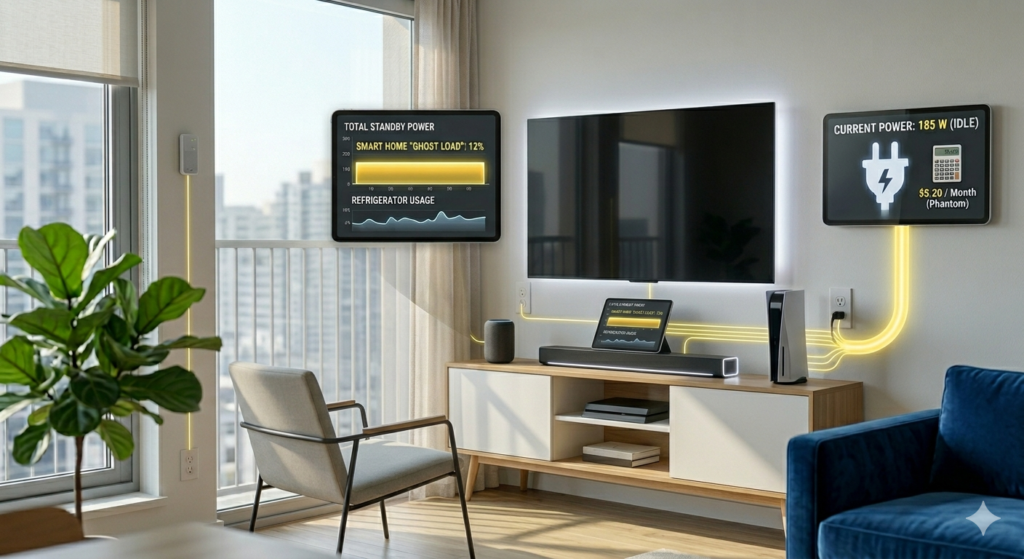
The promise of the smart home in 2026 is convenience, security, and efficiency. We have voice-activated lights, AI-driven thermostats, and appliances that “talk” to each other. However, as I sat in my quiet living room last month, looking at my real-time energy monitor, I noticed something unsettling. Even with every light off and no appliances running, my home was still pulling a steady, silent stream of electricity. At orhpositivo, I decided to go on a “Ghost Hunt” to measure the exact impact of “Phantom Power”—the energy consumed by devices when they are technically turned off but remain in standby mode. What I found was a digital leak that was quietly draining my bank account every single month.
The Myth of the “Off” Switch in a Connected World
For years, we’ve been told that modern electronics are energy-efficient. While it’s true that an LED bulb uses less power than an old filament, the sheer number of connected devices in our 2026 homes has created a new problem. A “smart” device is never truly off; it is always listening for a voice command, waiting for a Wi-Fi signal, or maintaining a cloud connection.
I started my investigation with a high-precision plug-in power meter. I was shocked to find that my “energy-saving” smart speaker was pulling nearly 3 watts of power while sitting completely idle. While 3 watts sounds negligible, when you multiply that by five speakers, three smart displays, and a dozen connected light switches, the “base load” of the house starts to climb significantly. This is what engineers call the “vampire load,” and in a fully integrated smart home, it is a constant, 24/7 drain that never sleeps.
My 30-Day Energy Audit: The Figures That Mattered
To get to the bottom of this, I spent an entire weekend unplugging every non-essential device and measuring their individual standby draw. I tracked the figures over a 30-day period to see the cumulative effect. The results were a wake-up call for anyone trying to manage a household budget in 2026.
I discovered that my home theater setup—the OLED TV, the soundbar, and the gaming console—was the biggest offender. Even in “Instant On” mode, this cluster was consuming more electricity in standby over a month than my high-efficiency refrigerator uses to actually keep my food cold. By the end of the month, I calculated that approximately 12% of my total utility bill was paying for “leaked” energy—power that provided zero functional value during the hours I was sleeping or at work. For a typical urban household, this invisible leak can easily equate to the cost of a high-end streaming subscription or a few weeks of groceries.
The 2026 Smart Home Paradox: Efficiency vs. Connectivity
One of the most interesting facts I uncovered is the “Connectivity Tax.” In 2026, many manufacturers have prioritized fast response times over deep sleep modes. When a smart bulb stays connected to your Zigbee or Thread network, it requires a constant trickle of power to remain “awake.”
I experimented with two different brands of smart plugs. Brand A focused on “Instant Response” and consumed 1.5 watts in standby. Brand B utilized a newer “Eco-Sync” protocol that only checked the network every few seconds, reducing its standby draw to 0.4 watts. Over a year, if you have 20 of these plugs around your house, the difference between Brand A and Brand B isn’t just a few cents—it’s a significant figure that affects your home’s total carbon footprint and your annual expenses. We are living in a paradox where the very devices meant to help us save energy are sometimes the ones wasting it the most.
Strategic Solutions for Plugging the Digital Leak
Once I saw the figures, I couldn’t ignore them. I began implementing a “Passive Energy Defense” strategy that didn’t sacrifice convenience but stopped the waste. The most effective tool I found was the “Master-Slave” power strip. I plugged my TV into the master outlet; now, when the TV is turned off, the power to the soundbar and game console is physically cut, preventing them from entering their high-power standby states.
I also moved my non-essential smart hubs to mechanical timers. There is no reason for my outdoor smart lighting hub to be powered on at 2 AM when everyone is asleep. By setting a simple schedule that kills the power to these “gateways” for six hours a night, I reduced my home’s idle power consumption by another 5%. These small, tactical changes proved that you don’t need to live in the dark to be energy-efficient; you just need to be smarter than your smart devices.
Investing in “Deep Sleep” Hardware
Moving forward into 2026, my procurement strategy for new tech has changed. I no longer look just at the peak performance specs; I look at the “Deep Sleep” certifications. I’ve started prioritizing devices that support the latest energy-efficient communication standards, which allow sensors to remain dormant for longer periods without losing their connection.
In my recent upgrade of our home network, I chose a router with “Target Wake Time” (TWT) features. This allows my smart devices to negotiate when and how often they wake up to ping the network. Not only does this reduce the phantom power draw of the devices, but it also extends the battery life of my wireless security cameras by nearly 20%. It is a rare win-win situation where technology is finally being engineered to solve the problems it created.
Final Thoughts: Taking Control of the Invisible
After a month of tracking the facts and analyzing the figures, my verdict is that we can no longer afford to be passive consumers. The “Invisible Leak” is a reality of the modern connected lifestyle, but it is one we have the tools to fix. By conducting a simple audit and being mindful of the standby states of our electronics, we can reclaim a significant portion of our energy budget.
A smart home should work for you, not the other way around. If your devices are consuming power while you sleep without providing a service, they aren’t “smart”—they are just inefficient. The takeaway is simple: if you want to protect your financial health and your home’s efficiency in 2026, start looking at the numbers when the lights are off. The facts are in the shadows, and the savings are waiting to be found.