We live in an age of unprecedented information abundance, yet many of us feel more confused and overwhelmed than ever before. For a long time, I was a passive consumer of whatever the algorithms decided to feed me. I spent my mornings scrolling through a chaotic mix of outrage-inducing headlines, celebrity gossip, and “get-rich-quick” schemes. I was “informed” about everything but understood nothing deeply. My brain felt like it was constantly buzzing with digital static, leaving me with zero mental space for original thought or deep work.
I realized that just as my physical health is a reflection of what I eat, my mental health and intellectual performance are reflections of the data I consume. I decided to treat my digital feed like a professional pantry that needed a complete, ruthless audit. I embarked on a mission of “Information Curation”—shifting from a passive victim of the algorithm to an active architect of my own digital environment. Here is the story of how I eliminated the “digital trash” and built a feed that actually fuels my growth.
The Algorithmic Trap: Understanding Why Your Feed is “Loud”
The first step in my journey was a technical realization: social media platforms are not designed to inform you; they are designed to keep you engaged. The algorithms prioritize high-arousal emotions like anger, fear, and shock because those are the emotions that keep people clicking. This creates a “Loudness Bias” where the most extreme, least nuanced information rises to the top, while calm, high-quality, and complex insights are buried.
I had to acknowledge that my brain was being technically manipulated. Every time I engaged with a “trash” post out of irritation, I was telling the algorithm: “Give me more of this.” To fix my feed, I had to stop fighting the algorithm and start starving it. I made a commitment to never click on a headline that used “clickbait” language or extreme emotional triggers. This was the first technical barrier I built to protect my intellectual peace.
The Ruthless Unfollow: Pruning the Digital Garden
I sat down one Saturday and performed a “Digital Pruning” session. I went through every single account I followed on LinkedIn, Twitter (X), and Instagram with a simple, brutal question: “Has this account provided me with a unique, high-quality insight in the last 30 days?”
If the answer was no, or if the account mostly posted repetitive “hustle culture” memes or political rage, I unfollowed them immediately. I didn’t mute them; I unfollowed them. I realized that “muting” is a half-measure that still leaves digital clutter in your background processes. I cut my “Following” lists by nearly 70%. The result was a sudden, beautiful silence. My feed stopped being a shouting match and started becoming a library of my own choosing. I learned that a curated feed is defined more by what you don’t see than what you do.
Transitioning from “Push” to “Pull” Information
One of the most important technical shifts I made was moving from “Push” information to “Pull” information. Social media is a “Push” environment—content is pushed into your face without you asking for it. This is the primary source of digital overwhelm.
I started prioritizing “Pull” sources—newsletters, high-quality RSS feeds, and specialized forums where I have to intentionally go to seek out information. I subscribed to five deep-dive newsletters written by experts in their fields—people with “skin in the game” rather than just “content creators.” Because these go to my inbox, I choose when to read them. I am the one pulling the data, which means my brain is in a proactive, analytical state rather than a reactive, passive state. This technical change alone increased my learning efficiency by tenfold.
The Quality Filter: Identifying “Signal” vs. “Noise”
How do I determine what is worth my time? I developed a three-step “Signal Filter” for every piece of content I consume.
The Source Filter: Does this person have actual experience in what they are talking about, or are they just a “curator” of other people’s ideas?
The Nuance Filter: Does the content acknowledge the complexity and “gray areas” of the topic, or is it presented as a simple “black and white” truth?
The Longevity Filter: Will this information still be relevant in six months, or is it just a reaction to today’s news cycle?
If a piece of content fails these filters, I move on. I’ve learned to value “Slow Information”—long-form essays and books—over “Fast Information.” I realized that most “news” is just noise disguised as importance. By focusing on evergreen knowledge, I am building a mental foundation that grows stronger over time, rather than a house of cards built on daily trends.
Creating Digital “Sanctuaries” for Different Modes
I used to use the same device for work, entertainment, and social interaction. This was a technical mistake because it allowed “context bleeding”—where a work email would pop up while I was trying to relax, or a social media notification would distract me during a work session.
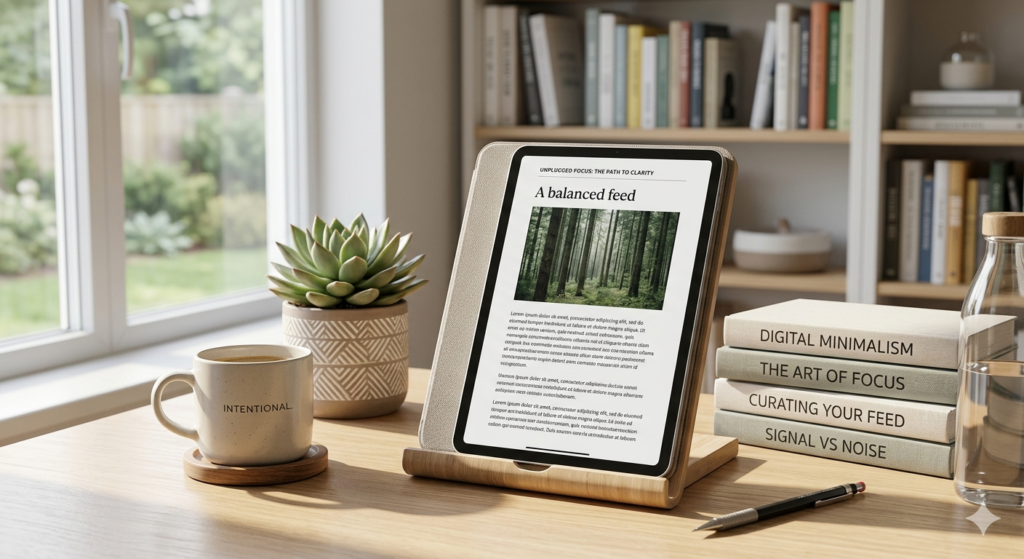
I decided to create digital “sanctuaries.” My tablet is now strictly for reading books and long-form articles (no social media apps allowed). My phone is for communication and utility only. My laptop is for creation. By physically and digitally separating these modes, I’ve trained my brain to know exactly what kind of information to expect when I pick up a specific device. This “Physical Curation” has significantly reduced my decision fatigue and helped me maintain a cleaner “Information Diet.”
The Psychological Reward of the “Deep Feed”
The most surprising part of this journey was the shift in my own psychology. When my feed was full of “trash,” I felt constant anxiety and a sense that the world was falling apart. Now that my feed is full of high-quality science, philosophy, and practical technical insights, I feel optimistic and capable.
I’ve realized that a high-quality feed doesn’t just give you better facts; it gives you a better perspective. I am no longer outraged by the trivial; I am inspired by the profound. I have more “Aha!” moments in a single day than I used to have in a month. This is the real power of curation: it changes the quality of your thoughts, and your thoughts change the quality of your life.
Final Thoughts: Becoming a Sovereign Consumer
In a world that wants to sell your attention to the highest bidder, being a sovereign consumer of information is an act of rebellion. You are the only person who can protect your mind from the digital smog.For the community at orhpositivo.com, my advice is to start your “Information Fast” today. Unfollow ten accounts that make you feel stressed or annoyed. Subscribe to one high-quality, long-form newsletter that challenges your thinking. Stop scrolling and start selecting. Your brain is a high-performance machine, but it can only run as well as the fuel you give it. When you cleanse your feed, you aren’t just “cleaning up your apps”—you are reclaiming your ability to think for yourself.