
For the longest time, I considered myself a champion of multitasking. I would have twenty browser tabs open, music playing, and my phone sitting right next to my keyboard, buzzing with every “like” and news alert. I felt busy, but at the end of every day, I felt an empty sense of frustration. I was moving a mile wide but only an inch deep. I was producing “shallow work”—tasks that were easy to replicate and didn’t require much brainpower—while my most important goals sat untouched.
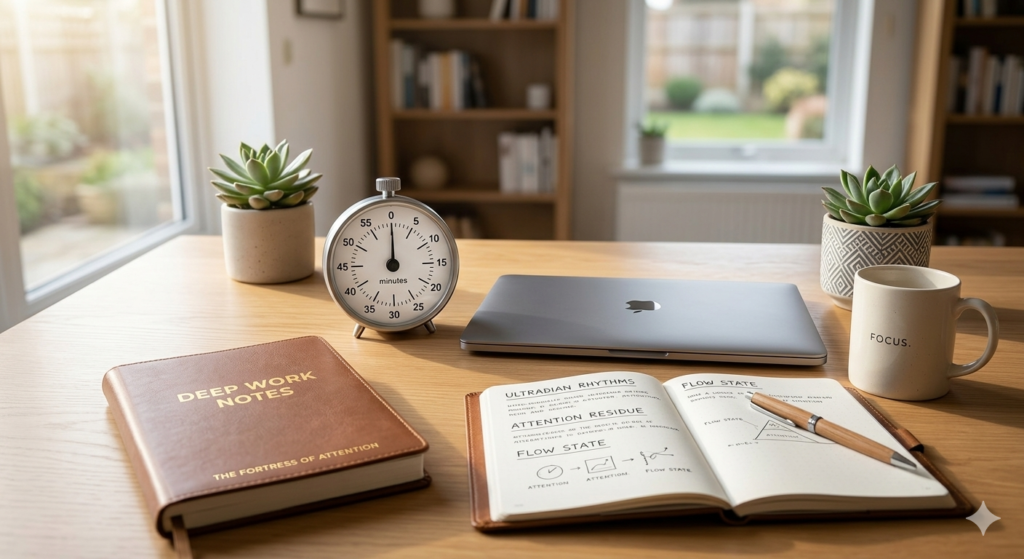
I realized that my ability to focus was a muscle that had become dangerously weak. We live in an “Attention Economy,” where billion-dollar companies hire engineers specifically to keep us distracted. To fight back, I had to stop trying to “manage my time” and start managing my focus. I decided to implement a technical 90-minute “Deep Work” ritual. Here is the honest story of how I rewired my brain to stay concentrated in a world designed to distract us.
The Cognitive Cost of the “Quick Check”
The biggest lie I used to tell myself was, “I’ll just check my phone for ten seconds.” I didn’t realize the technical concept of Attention Residue. Research shows that when you switch from a task to a notification and back again, a part of your brain stays stuck on that notification for up to 20 minutes.
Every “quick check” was effectively sabotaging my IQ for the next hour. I realized that if I checked my phone three times an hour, I was never actually working at full capacity. This realization was my turning point. I stopped viewing my phone as a tool and started viewing it as a cognitive leak. To achieve deep work, I had to build a fortress around my attention where no “quick checks” were allowed.
Building the “Black Box” Environment
I learned that willpower is a finite resource. If my phone is sitting on my desk, my brain is using energy just to not look at it. To save that energy for my work, I had to re-engineer my physical space.
I started a ritual I call the “Black Box.” Before my 90-minute deep work session begins, my phone is physically moved to another room. I don’t just turn it over; I remove the visual trigger entirely. I also use a technical browser blocker to shut down social media sites on my laptop. When I sit down at my desk, there is literally nothing else I can do but the task at hand. By removing the choice to be distracted, I saved my mental energy for the actual creative problem-solving.
The 90-Minute Pulse: Working with My Biology
Why 90 minutes? I discovered that our bodies operate on ultradian rhythms. Just as we have sleep cycles, our brains have cycles of high-frequency brain activity followed by a period of fatigue.
In the past, I tried to work for four hours straight and ended up scrolling through news sites by the second hour because my brain was exhausted. Now, I set a physical timer for 90 minutes. This creates a “sprint” mentality. Knowing that the clock is ticking makes me less likely to wander off. I treat these 90 minutes as a sacred block of time where the outside world simply does not exist. The relief of knowing I have a scheduled break at the end allows me to dive deeper into the work without feeling the “itch” to escape.
Embracing the Boredom: The First 15 Minutes
The hardest part of deep work isn’t the work itself; it’s the “boredom gap” at the beginning. I used to think that I should feel “inspired” before I started. I was wrong. The first 15 to 20 minutes of any deep work session usually feel uncomfortable. My brain is still trying to process the “shallow” noise of the morning, and it fights against the effort of concentration.
I learned to expect this friction. I call it the “Focus Warm-up.” Instead of quitting when I feel bored or stuck, I sit with the discomfort. I’ve realized that the “magic” of deep work happens on the other side of that 15-minute wall. Once I cross that threshold, I enter a “Flow State”—that incredible feeling where time disappears and the work feels like it is doing itself. If you give up at the first sign of boredom, you never get to experience the high-performance zone.
The Digital Sabbath and the “Shutdown Ritual”
Deep work isn’t just about what you do at your desk; it’s about how you train your brain during your “off” hours. If I spend every spare second at the grocery store or in line for coffee looking at my phone, I am teaching my brain that it can never be bored. This makes deep work almost impossible.
I started practicing “Productive Boredom.” I let my mind wander while I wash the dishes or walk the dog. I also implemented a “Shutdown Ritual” at the end of the day. I write down the three most important things I need to focus on for the next morning and then I tell myself, “Work is done.” This technical off-switch prevents “Zeigarnik Effect”—the tendency of our brains to keep ruminating on unfinished tasks. When I start my deep work session the next day, my brain is rested and ready, rather than exhausted from a night of digital clutter.
Quality Over Quantity: The Results of the Deep Work Shift
Since I started this 90-minute practice, my output has changed dramatically. I used to work 10-hour days and feel like I accomplished nothing. Now, I do two 90-minute blocks of deep work, and I realize I’ve done more in those three hours than I used to do in an entire week.
I’ve learned that 3 hours of deep, focused effort is worth more than 12 hours of distracted “busyness.” This realization gave me my life back. Because I am so much more efficient during my deep work blocks, I have more time for my hobbies, my family, and my rest. I am no longer “working all the time” but failing to get things done. I am working intensely for a short period and then truly living the rest of the day.
Final Thoughts: The Competitive Advantage of Focus
In the future, the ability to concentrate will be the most valuable currency in the world. As AI and automation handle more of our shallow tasks, the only thing left for humans is the ability to solve complex, deep problems.
If you want to grow your career or your own business like orhpositivo.com, you must protect your attention like it’s your most valuable asset. Start small. Try one 60-minute block without your phone. Feel the discomfort, stay with it, and watch what happens on the other side. You aren’t just getting work done; you are reclaiming your mind from a world that wants to sell it to the highest bidder.