
For the longest time, I viewed my monthly electricity bill as a mysterious, uncontrollable monster. Every month, a number would appear in my inbox, and I would pay it with a sigh, assuming that this was simply the “cost of modern living.” I lived in a cycle of cranking the air conditioning during humid afternoons and leaving every appliance on standby, never once questioning where that energy was actually going.
However, earlier this year, a sudden spike in utility rates forced me to take a hard look at my household habits. I set a goal for myself: could I actually reduce my energy consumption by 30% without living in the dark or feeling like I was back in the Stone Age? After three months of testing technical gadgets and tweaking my daily routines, I realized that saving energy isn’t about big, expensive investments like solar panels; it’s about understanding the “silent leaks” in our homes. Here is the story of how I reclaimed my budget.
The Shocking Discovery of “Vampire Power”
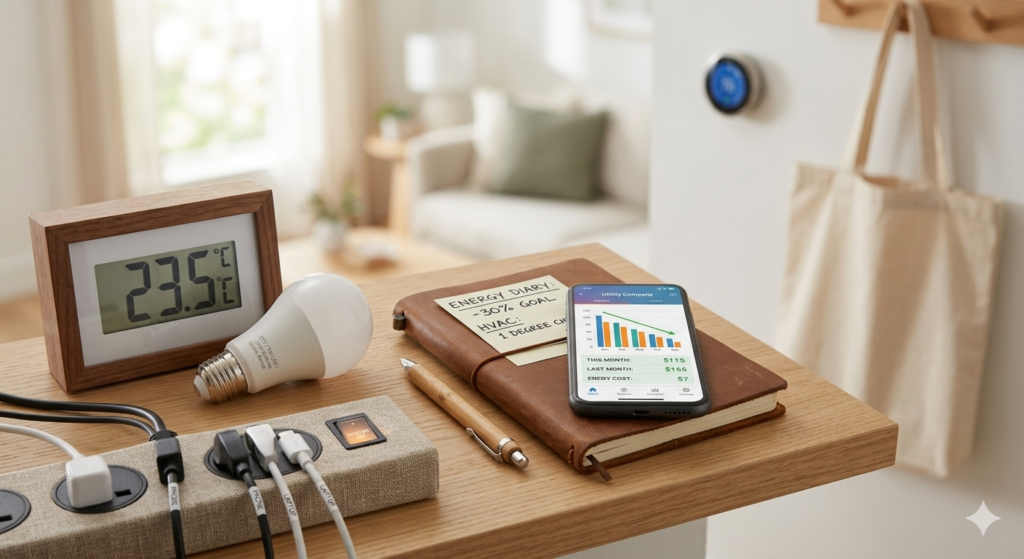
The first step in my journey was becoming a “detective” in my own living room. I had heard the term “Phantom Loads” before, but I always thought it was an exaggeration. I decided to buy a simple energy monitor plug to see how much power my devices were drawing when they were supposed to be “off.”
What I found was eye-opening. My coffee maker, the microwave clock, my idle gaming console, and even the laptop charger I left plugged in 24/7 were constantly sipping electricity. Individually, they used tiny amounts, but collectively, they were responsible for nearly 10% of my baseline bill. These devices aren’t truly off; they are in a “ready” state, waiting for a signal that may never come while I’m at work or asleep.
To fix this, I didn’t go around unplugging everything manually—that’s too much work. Instead, I invested in a few smart power strips. I grouped my home office gear together and my entertainment system together. Now, when I finish work, I flip one master switch, and every “vampire” in that zone is truly cut off from the grid. It felt incredibly satisfying to see my energy monitor drop to near zero for the first time.
Rethinking Heat: The Thermostat Strategy
Heating and cooling were, by far, my biggest expenses. In the past, my approach was reactive: if I felt a little warm, I’d drop the AC by five degrees. If I felt a chill, I’d blast the heater. This “yo-yo” effect is the most inefficient way to run an HVAC system because the motor has to work at maximum capacity to reach those extreme targets.
I learned about the “One-Degree Rule.” Research suggests that for every degree you move your thermostat closer to the outside temperature, you save about 3% on your energy usage. I decided to challenge myself: I raised my summer AC setting from 22°C to 24°C. For the first two days, I noticed it, but by day three, my body adjusted.
To help, I started using ceiling fans more effectively. A fan doesn’t lower the temperature of a room, but it creates a wind-chill effect on your skin, making you feel about 2-3 degrees cooler. By combining a slightly higher thermostat setting with a low-wattage fan, I kept my comfort level the same while my AC compressor took much longer breaks.
The Water Heater: A Hidden Giant
One evening, I went into the utility closet and touched the side of my water heater. It was warm to the touch. That heat I was feeling through the metal casing was energy I had paid for that was simply escaping into the air.
Most manufacturers set water heaters to 60°C (140°F) by default. This is often far hotter than anyone actually needs for a shower or for washing dishes. In fact, keeping water that hot is a safety hazard and causes minerals to build up faster in the tank. I turned the dial down to 49°C (120°F).
The result? I didn’t notice any change in my morning shower, but the heater didn’t have to cycle on nearly as often to maintain that temperature. I also added a “water heater blanket”—a simple piece of insulation—to wrap the tank. This technical tweak alone felt like a permanent 5% raise in my monthly disposable income.
My Shift to “Cold and Slow” Laundry
Laundry used to be a chore I did without thinking. I’d throw everything in on a “Warm/Hot” cycle and then toss it in the dryer for an hour. When I looked into the energy data, I was stunned to find that roughly 90% of a washing machine’s energy goes solely into heating the water. The actual spinning of the drum uses very little power.
I switched to cold-water detergents and started washing almost everything on the “Eco-Cold” setting. My clothes came out just as clean, and because cold water is gentler on fabrics, my favorite shirts didn’t shrink or fade as fast.
As for drying, I rediscovered the folding rack. On sunny days, I put it out on the balcony; on rainy days, I leave it in a ventilated room. The dryer is now reserved only for emergencies or heavy bedding. By removing one of the most high-wattage appliances from my daily routine, the dip in my electricity meter was immediate and dramatic.
Lighting: The Easiest “Win” I Ever Had
I used to be sentimental about the warm glow of old-fashioned incandescent bulbs. I thought LEDs were too “clinical” or blue. But when I realized that an incandescent bulb is basically a small heater that produces a little bit of light as a byproduct, I knew I had to make the switch.
I replaced every bulb in my house with high-quality, “warm-toned” LEDs. The difference in my power draw was staggering. A 60-watt equivalent LED only uses about 8 or 9 watts. In a house with 20 bulbs, that’s the difference between using 1,200 watts and 160 watts.
What I loved most about this technical upgrade was the longevity. I haven’t had to replace a single bulb in over a year. It’s a “set and forget” solution that pays for itself in just a few months of utility savings.
The Kitchen: Small Habits, Big Results
The kitchen is the heart of the home, but it’s also an energy-intensive zone. I used to preheat my large oven for almost everything—even just a small tray of roasted vegetables. I realized how much energy I was wasting heating up that massive empty space.
I started using my air fryer and toaster oven for 80% of my meals. They reach cooking temperature in two minutes and use about half the electricity of a full-sized oven. When I do use the big oven, I’ve learned to turn it off five minutes before the timer goes off. The residual heat trapped inside is more than enough to finish the cooking process.
Even the way I use the refrigerator changed. I realized I was “ghost-shopping”—standing with the door open while I decided what I wanted to eat. Now, I try to decide before I open the door. Keeping the cold air inside is one of the simplest ways to keep the compressor from working overtime.
Landscaping: My Long-Term Technical Solution
One thing I never considered was how the outside of my house affected the inside. I noticed that my home office got incredibly hot in the afternoon because the sun hit the large window directly.
Instead of buying reflective film, I planted a couple of fast-growing deciduous trees outside that window. In the summer, the thick leaves provide a natural “sunblock” for my house. In the winter, the leaves fall off, allowing the sun to peek through and naturally warm my office for free. This is “passive” technology at its best—using nature to solve an engineering problem.
The Psychological Shift: Monitoring the Progress
The final piece of the puzzle wasn’t a gadget or a habit, but a mindset. I started checking my utility company’s online portal every Sunday night. Seeing the bar graphs go down week after week became a source of pride.
I realized that energy efficiency isn’t about deprivation. I still watch my favorite shows, I still have a comfortable, cool home, and I still enjoy hot showers. The difference is that I am no longer wasting resources on things that don’t add value to my life.
Conclusion: A 30% Savings is Just the Beginning
By the end of my three-month experiment, my electricity bill had dropped by exactly 31%. Some of that came from the $50 I spent on LEDs and power strips, but most of it came from simply being aware.
For anyone else looking to cut their costs, my advice is to start small. You don’t have to change everything overnight. Pick one “vampire” to kill, adjust your thermostat by one degree, or try one week of cold-water laundry. Once you see that first lower bill, you’ll be hooked. Sustainable living isn’t just good for the planet; it’s the best financial gift you can give to yourself.