
When the current wave of Artificial Intelligence first arrived, I felt a mixture of excitement and deep skepticism. I saw people using these tools to generate thousands of words of generic text, and I feared that we were entering an era of “digital noise”—where quantity would completely replace quality. For a few months, I avoided AI entirely, believing that true productivity only came from the “manual labor” of the mind.
I was wrong. My breakthrough came when I stopped viewing AI as a “replacement” for my brain and started viewing it as a high-level technical intern. I realized that the real power of AI isn’t in doing the work for you; it’s in removing the “friction” that prevents you from doing your best work. I embarked on a personal experiment to integrate AI into my workflow as a co-pilot for summarizing complex data, brainstorming ideas, and accelerating my language learning. Here is the technical framework I developed to stay highly productive while keeping my human voice front and center.
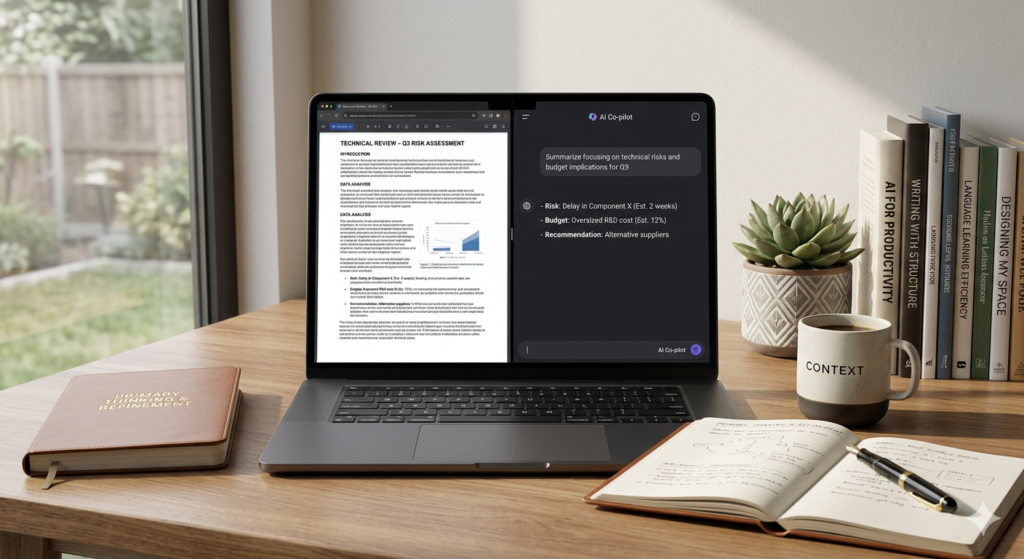
The Art of the Technical Digest: Summarizing Without Skimming
As someone who manages multiple projects, I am constantly bombarded with long-form reports, white papers, and lengthy email threads. In the past, I would spend hours “speed-reading,” often missing critical nuances because I was trying to move too fast. This is where I found my first major AI win.
I started using AI tools to create a “Technical Digest.” Instead of asking for a generic summary, I give the AI a specific lens: “Summarize this 50-page report focusing only on the technical risks and the budget implications for Q3.” By providing a specific persona and goal, the AI filters out the fluff and gives me exactly what I need to make a decision. This isn’t about skipping the reading; it’s about pre-processing the information so that when I do dive deep, I already have a mental map of the terrain. I’ve found that this saves me nearly five hours a week, allowing me to focus on high-level strategy rather than low-level sorting.
Breaking the “Blank Page” Syndrome: AI as a Sparring Partner
The most difficult part of any creative project is the transition from zero to one. I used to spend hours staring at a blinking cursor, waiting for inspiration to strike. I realized that my brain is much better at editing and refining than it is at generating ideas in a vacuum.
I now use AI as a “Brainstorming Sparring Partner.” When I have a rough idea for an article or a project, I feed the AI a few bullet points and ask it to “argue against my premise” or “provide five alternative perspectives I haven’t considered.” This is a crucial technical distinction: I am not asking the AI to write the piece; I am asking it to challenge my thinking. This process often reveals gaps in my logic or sparks a completely new angle that I wouldn’t have found on my own. By using AI as a sounding board, I’ve reduced my “stuck time” by 70%. The final output is still 100% mine, but the path to get there is much faster and more robust.
Accelerating Fluency: The 24/7 Language Tutor
Learning a new language is one of the most cognitively demanding tasks a person can undertake. Traditional methods—like apps that focus on repetitive drills—often fail because they lack the “contextual immersion” needed for true fluency. I decided to turn AI into a personalized language immersion lab.
I use AI to practice conversational scenarios that are specific to my life. For example, instead of learning how to order a coffee, I ask the AI to roleplay a technical negotiation in my target language. This allows me to practice the specific vocabulary I actually need. Additionally, I use AI to “deconstruct” complex sentences. If I find a paragraph in a foreign newspaper that I don’t understand, I ask the AI to break down the grammar and provide three other examples of how that specific verb tense is used in a professional context. This immediate, high-context feedback loop has accelerated my learning pace significantly more than any textbook ever could.
The “Human-in-the-Loop” Rule: Avoiding the Trap of Mediocrity
The biggest danger of AI is the temptation to get “lazy.” If you let the AI do the thinking, your work will become beige, boring, and ultimately valueless. I developed a strict technical rule for myself: The Human-in-the-Loop.
I never use an AI output as a final product. I treat AI like a rough draft or a set of raw materials. After the AI provides a summary or a list of ideas, I apply my own experience, my own humor, and my own ethical judgment. I look for the “hallucinations” (the errors AI sometimes makes) and I ensure that the tone matches my personal brand. Google’s search algorithms are becoming incredibly good at detecting “low-effort” AI content. To stay relevant on orhpositivo.com, I must ensure that every piece of content has a “soul”—something that only a human with real-world experience can provide.
Managing the “Prompt Engineering” Curve
I realized that the quality of the AI’s help is directly proportional to the quality of my instructions. In the beginning, my prompts were vague, and the results were mediocre. I had to learn the technical skill of “Contextual Prompting.”
I found that giving the AI a “Constraint” is more effective than giving it an “Instruction.” Instead of saying “Give me ideas for a blog,” I say “Give me three controversial opinions on productivity that a minimalist would agree with, but a traditional corporate manager would hate.” These constraints force the AI to move away from generic patterns and provide more interesting, nuanced data. Mastering the “Ask” is the most important technical skill of the next decade. It turns the AI from a simple search engine into a powerful analytical tool.
The Ethical Boundary: Protecting My Originality
There is a fine line between using AI for productivity and using it as a crutch that atrophies your own skills. I am very careful to protect my “Primary Thinking” time. I still spend the first hour of my day with a physical notebook and a pen, away from all screens. I want my initial thoughts to be pure and uninfluenced by an algorithm.
I use AI to help me scale my ideas, not to originate them. By keeping my brainstorming and “deep work” sessions separate from my AI-assisted sessions, I ensure that my creative voice remains independent. Productivity isn’t just about speed; it’s about the quality of the output. If AI helps me move faster but makes me think less, then I have failed. The goal is to use the machine to reach higher levels of human performance.
Final Thoughts: The Hybrid Future of Work
The future of productivity isn’t “Human vs. AI”; it is “Human + AI.” Those who refuse to use these tools will be left behind by the sheer volume of information they have to process. But those who use them to automate their thinking will be replaced by the very algorithms they rely on.
For my journey on orhpositivo.com, AI has become a vital technical companion. it allows me to summarize the noise, brainstorm the possibilities, and learn new skills at a rate that was previously impossible. But at the end of the day, I am the one who signs my name to the work. I am the one who provides the empathy, the ethics, and the unique perspective. AI is a powerful wind in my sails, but I am still the captain of the ship.